Materials & conditions
Material selection for demanding conditions
Define temperature and duration, media, parent material and screw pairing, loads and maintenance. Alloy name is a starting point; product condition, finish and joint validation determine suitability.
Scope: Early material review for wire inserts. Discussed material routes do not confirm availability of every combination.
Describe measurable conditions
| Condition | Information to provide |
|---|---|
| Temperature | Normal and peak values, duration, cycles and simultaneous loading. |
| Media | Identity, concentration, exposure, temperature, retention and cleaning. |
| Mating materials | Parent material, screw, finishes, lubrication and dissimilar-metal contact. |
| Maintenance | Cycles, screw replacement, contamination and servicing requirements. |
| Acceptance | Required performance, test conditions, report scope and customer specification. |
Compare materials with their conditions
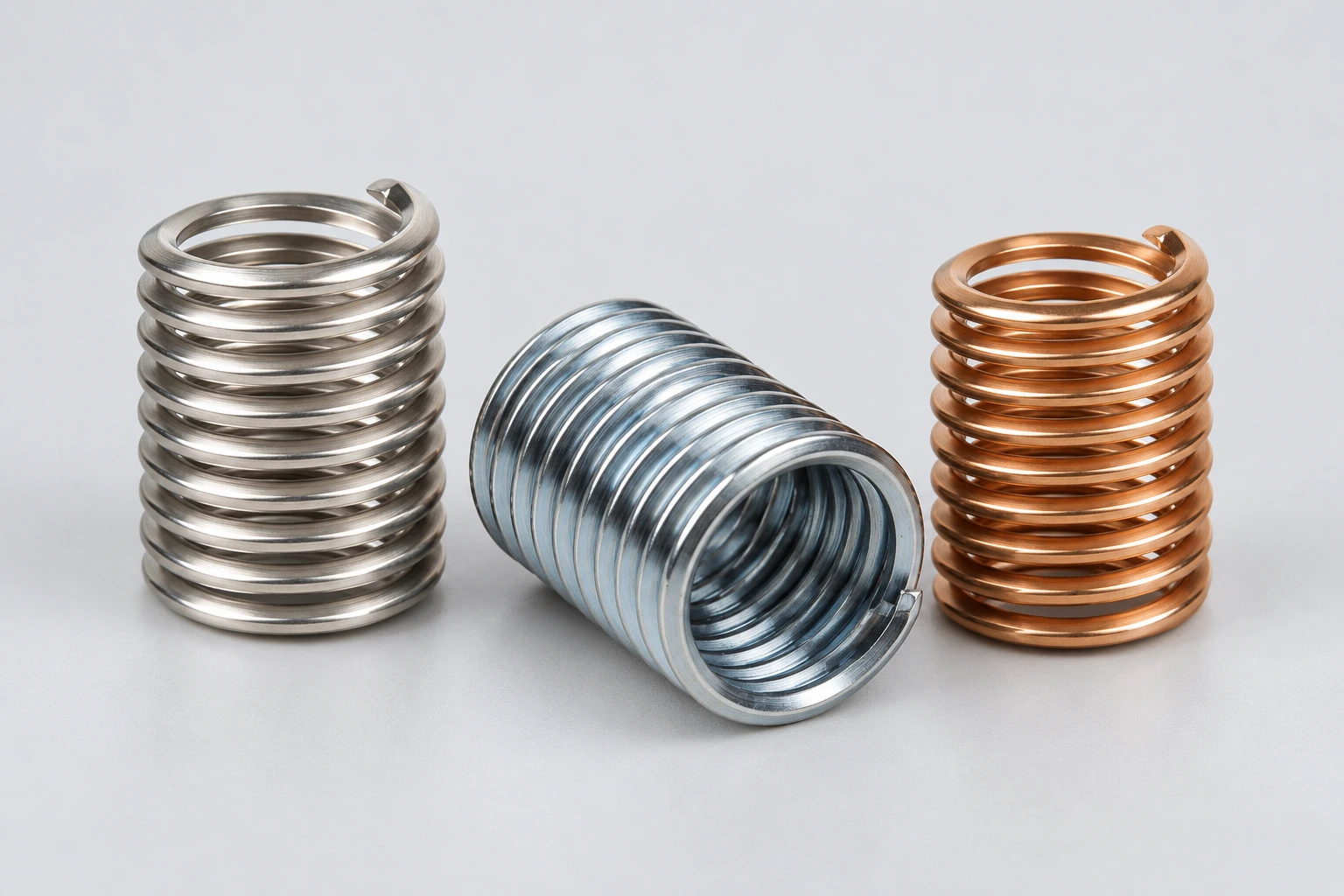
304 stainless steel is a conventional discussion route. Anti-galling alloys, high-temperature alloys, phosphor bronze and titanium each require different evaluations rather than one universal ranking.
Nitronic 60 is often considered for galling resistance and Inconel X-750 for elevated-temperature applications. Product condition, mating materials and actual exposure still require review.
Typical raw-material properties are not guaranteed finished-insert properties or direct ratings for joint temperature, strength or life.
| Material | Selection considerations | Specifications & part numbers |
|---|---|---|
| 304 stainless steel inserts | Conventional material route | Find part numbers → |
| Nitronic 60 inserts | Galling-resistance evaluation | Find part numbers → |
| Inconel X-750 inserts | Elevated-temperature evaluation | Find part numbers → |
| Phosphor bronze inserts | Mating materials, media and delivery condition | Find part numbers → |
| Titanium inserts | Weight, media and mating conditions | Find part numbers → |
Material filters identify catalogue specifications, not stock for every size, finish and packaging combination. Include service conditions, complete part number, quantity and required material documents in your enquiry.
Review the complete joint
The insert, parent thread, screw and bearing surfaces all contribute. Changing insert material alone does not resolve parent-material softening, corrosion, relaxation or mating problems.
Salt spray, immersion, thermal cycling, vacuum and process gases represent different conditions. Test results apply only within their established scope.
Separate knowledge from confirmed supply
Discuss candidate materials, then confirm size, delivery condition, finish, tooling and documents. Define methods, samples and acceptance scope for any special validation.
Common questions
Does crossing one temperature require a particular alloy?
Assess duration, load, product condition and mating components together rather than using a universal cut-off.
Is stainless steel absolutely non-magnetic?
Response depends on alloy and processing. Specify a method and limit and verify the actual product for low-magnetic requirements.
Citation and scope
ZCOIL. Material selection for demanding conditions. 2026-10-30. https://www.zcoiltech.com/en/technical/material-and-service-conditions
Prepared by ZCOIL for product selection and technical discussion. Applicable drawings and confirmed documents define dimensions, processes and acceptance requirements.